⌁
Temporal detection
Detect sustained changes-not merely isolated spikes-using historical baselines and transparent surveillance models.
- EWMA and CUSUM
- Change-point detection
- Seasonal adjustment
Salus Agentic is the living intelligence and attestation layer for public health laboratories: coded tests, regulatory change, and guardrailed agents, always under human oversight, always with an audit trail.
Decision support only. Local CLIA, state law, and medical director judgment control.
Decision support only. Local CLIA certification, state law, and medical director judgment control all testing and reporting. Salus Agentic does not perform regulated testing and does not replace a laboratory director.
How the platform is constrainedCMS CLIA, OIG LEIE, CDC and APHL guidance, state reportable lists, and court outcomes, translated into operational implications instead of static binders.
02Structured entries for respiratory, arboviral, enteric, biothreat, AMR, and pathogen-agnostic methods, with LOINC, SNOMED CT, and ELR notes on every card.
03Validation outlines, SOP skeletons, and jurisdictional mapping that cite sources, leave an audit trail, and require a human before anything becomes operational.
04LEIE and SAM screening guidance, documentation completeness checks, and exportable evidence packages suitable for a CLIA survey or an OIG inquiry.
05Versioned test definitions, coded result sets, and lab-routed packs other public health laboratories can install without retyping a single LOINC.
Fictional, non-PHI demonstration. Conrad proposes. A human still holds the switch. Nothing here is a live accession, a live ELR send, or a live grant filing.
Selected pack
Influenza A H5 (HPAI) · lab MOL · LOINC 68986-9 · emerging
One click from the community registry. Molecular packs land in MOL, enteric toxins in ENT, wastewater in WAT. Destination: STATE-ELR + IHR note.
Data modernization, surge intake, grant justification, and genomics on the same specimen. Each page says what ships and what we will not claim.
ELR, eCR, AIMS routing, and USCDI+ vocabulary as product. We implement the laboratory messages. We do not claim to be your QHIN, and we do not advertise a 0% reject rate.
When CDC or WHO drops a protocol, pull the coded pack from the community registry. Destination lab is already on the bundle. Conrad proposes the surge accession. A human still confirms.
Conrad tags volume, TAT, and interoperability work to ELC, PHEP, and DMI categories so a director can export a justification. He never files a CDC report alone.
Sequence, AMR markers, wastewater, and IHR-relevant notes stay on the specimen. Orchestration runs in the jurisdiction tenant under CLIA validation. Not a laptop pipeline in email.
| What directors ask | Legacy LIMS | Salus |
|---|---|---|
| We do not have IT staff to maintain servers. | Pay a professional-services retainer to keep the database alive. | BYO-Snowflake or hosted Snowflake. The application layer is stateless. Agents do not replace your Snowflake admin of record. |
| What happens when the next outbreak hits? | Submit a change order to build new accessioning forms. | Install a coded pack from the registry. Conrad drafts bulk accessioning. The kill switch stays with the supervisor. |
| Will we lose control of our data? | No, but it is trapped in a proprietary schema. | You own the tenant. Full-fidelity export is a button. Data never has to leave the jurisdiction to use the LIMS. |
| How do we prove value to state leadership? | Export CSV files and rebuild the charts in Excel. | Command center, coded ELR completeness, and grant-tagged throughput. Conrad drafts the justification. A human still signs. |
LDTs remain under CLIA high-complexity rules, not the FDA device pathway. Public health laboratories keep the ability to iterate assays for novel or regional threats, but only if analytic validation, personnel competency, and documentation stay rigorous. Flexibility without a quality system is still a survey finding.
Laboratories should treat AI, NGS, and cyber resilience as quality-system topics now, not after a final rule. Document how any model is supervised, what it is forbidden to do (release, diagnose, transmit), and how an outage or surge is handled. Salus surfaces those expectations; it does not certify them.
A public health laboratory that touches federal program funds needs a repeatable LEIE/SAM workflow, not an annual PDF. Log who was screened, when, against which list, and who reviewed an alert. Global Hands supports the workflow. It does not itself bill federal programs or perform testing.
Every day, they see the first fragments of a larger story: one unusual result, then another; a wastewater increase; a cluster spanning counties; a new variant appearing quietly in the background.
Too often, those fragments remain separated by incompatible systems, manual spreadsheets, delayed interfaces, and organizational boundaries. By the time the pattern becomes obvious, the opportunity to act early may already be gone.
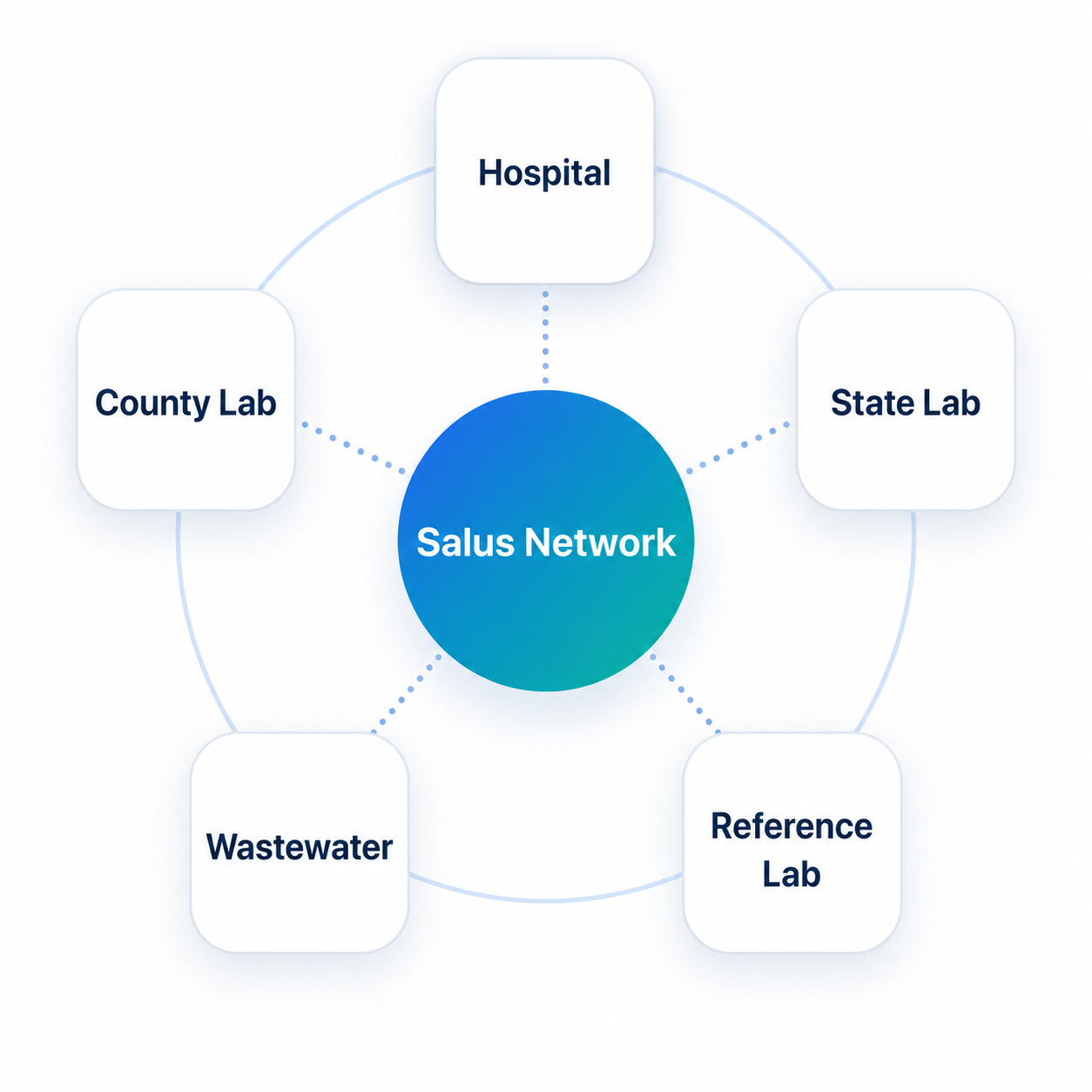
Salus changes the role of the laboratory information system. It unifies the work inside the laboratory, the reporting that leaves it, and the epidemiological intelligence that must follow. The result is not simply a modern LIMS. It is a living public-health network.
CDC describes ELR as a way to reduce manual entry errors and improve standardized, complete laboratory reporting. CDC also emphasizes that public-health data modernization must address outdated technology, complicated processes, and systems that do not work well together. Salus is designed directly around that mission.
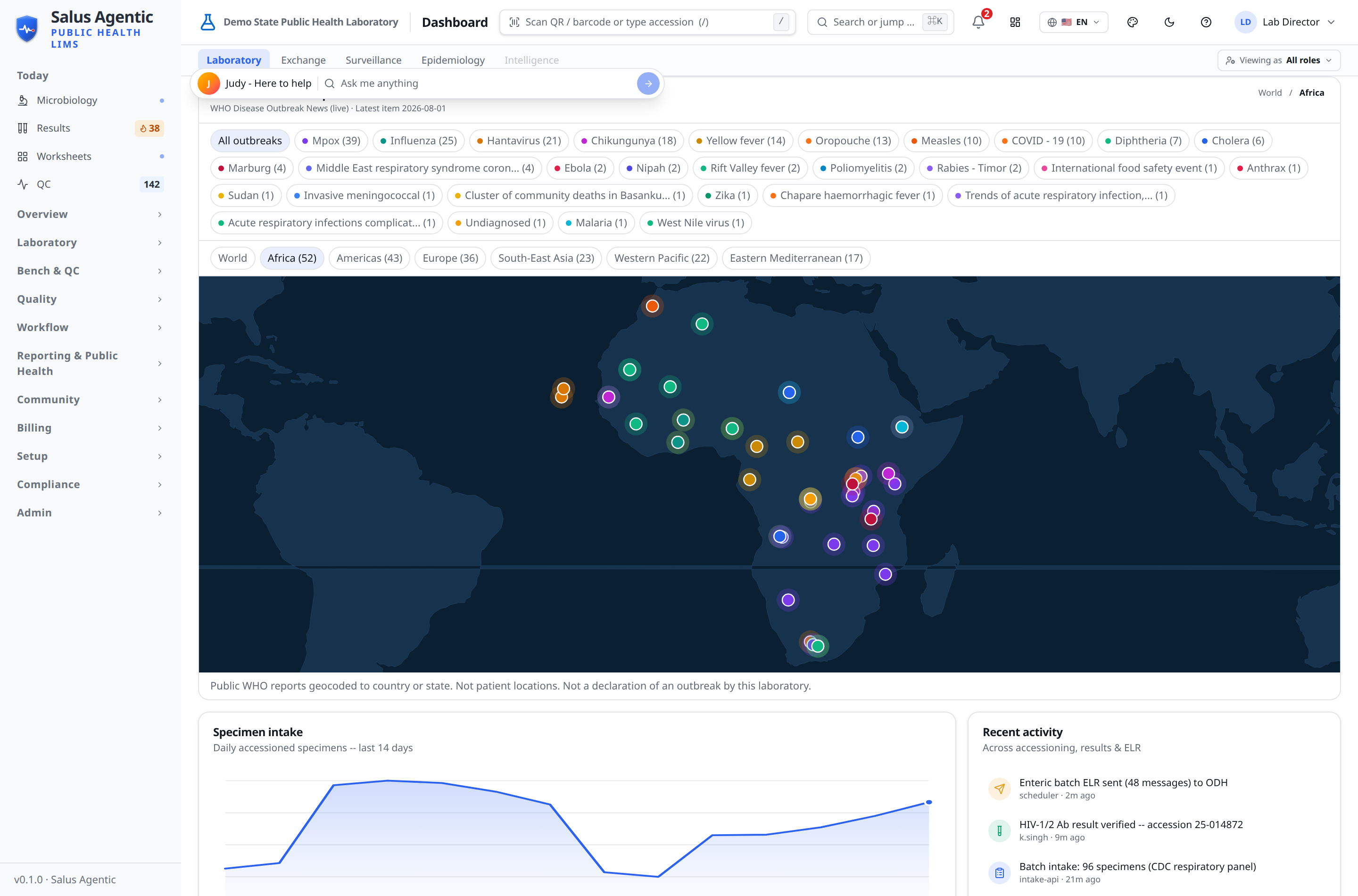
Every screen below is a live capture of the working application - the same dashboard, outbreak map, and results worklist a technologist or lab director uses every day.
Each layer is valuable on its own. Together, they create a continuous path from laboratory operations to evidence-backed public-health action.
Accessioning, testing, instruments, quality, chain of custody, result verification, inventory, and laboratory operations.
HL7, FHIR, ELR, eCR, instruments, terminology, secure routing, acknowledgments, and inter-laboratory exchange.
Historical baselines, trend analysis, anomaly detection, geospatial clusters, wastewater signals, and forecasts.
Cases, investigations, timelines, exposure relationships, hypotheses, outbreak workflows, and reporting.
Human-supervised agents that assemble evidence, correlate signals, explain risk, and accelerate investigation.
Salus combines laboratory truth with complementary public-health signals. It does not let an AI “declare” an outbreak. It builds an explainable evidence package for epidemiologists to review.
Detect sustained changes-not merely isolated spikes-using historical baselines and transparent surveillance models.
Reveal clusters across counties, facilities, schools, sewersheds, and neighboring jurisdictions while controlling geographic precision.
Compare wastewater movement with clinical and laboratory activity to identify community changes earlier.
Connect lineage, mutation, resistance, and sequence-cluster information with laboratory and geographic context.
Bring environmental, veterinary, foodborne, water, and vector signals into the same investigative picture.
Generate short-horizon forecasts with prediction intervals, model comparisons, and visible limitations.
Laboratories, clinical systems, wastewater programs, and environmental sources contribute governed data.
Salus validates, normalizes, deduplicates, geocodes, and preserves the provenance of every observation.
Statistical, geospatial, graph, and cross-source models identify meaningful departures from expected activity.
Epidemiologists review the evidence, open investigations, coordinate laboratories, and authorize escalation.
Conrad is the Salus Agentic voice, not an all-powerful chatbot. He has defined tools, permissions, evidence requirements, and approval boundaries.
The single in-product and public AI. Guides accessioning, results, QC, ELR, surveillance, and operations. Drafts the exhausting work. A human still signs and transmits.
Never releases or transmits aloneEvery laboratory and jurisdiction retains control of its detailed records. Salus shares only the signals, summaries, and authorized evidence required for collaboration.
Qualified public-health organizations receive the complete platform, not a stripped-down edition. The software license is $0 and there is no setup fee. Production funds hosting from $15,000 per year and a flat $7,500 per year for maintenance and support, so operations stay funded.
Enter the live Salus environment and experience laboratory operations, interoperability, surveillance, and agentic intelligence as one connected system.