
Pandemic relevanceVIRCOV2
SARS-CoV-2 RT-PCR
SARS-CoV-2 · NAA with probe detection
LOINC 94500-6 · Detected / Not detected / Inconclusive
Open the library cardSalus is more than a LIMS. It is a package registry for public health laboratory content. Labs publish shareable, versioned artifacts, the rest of the community adopts them, and producers are rewarded for what others put to use.
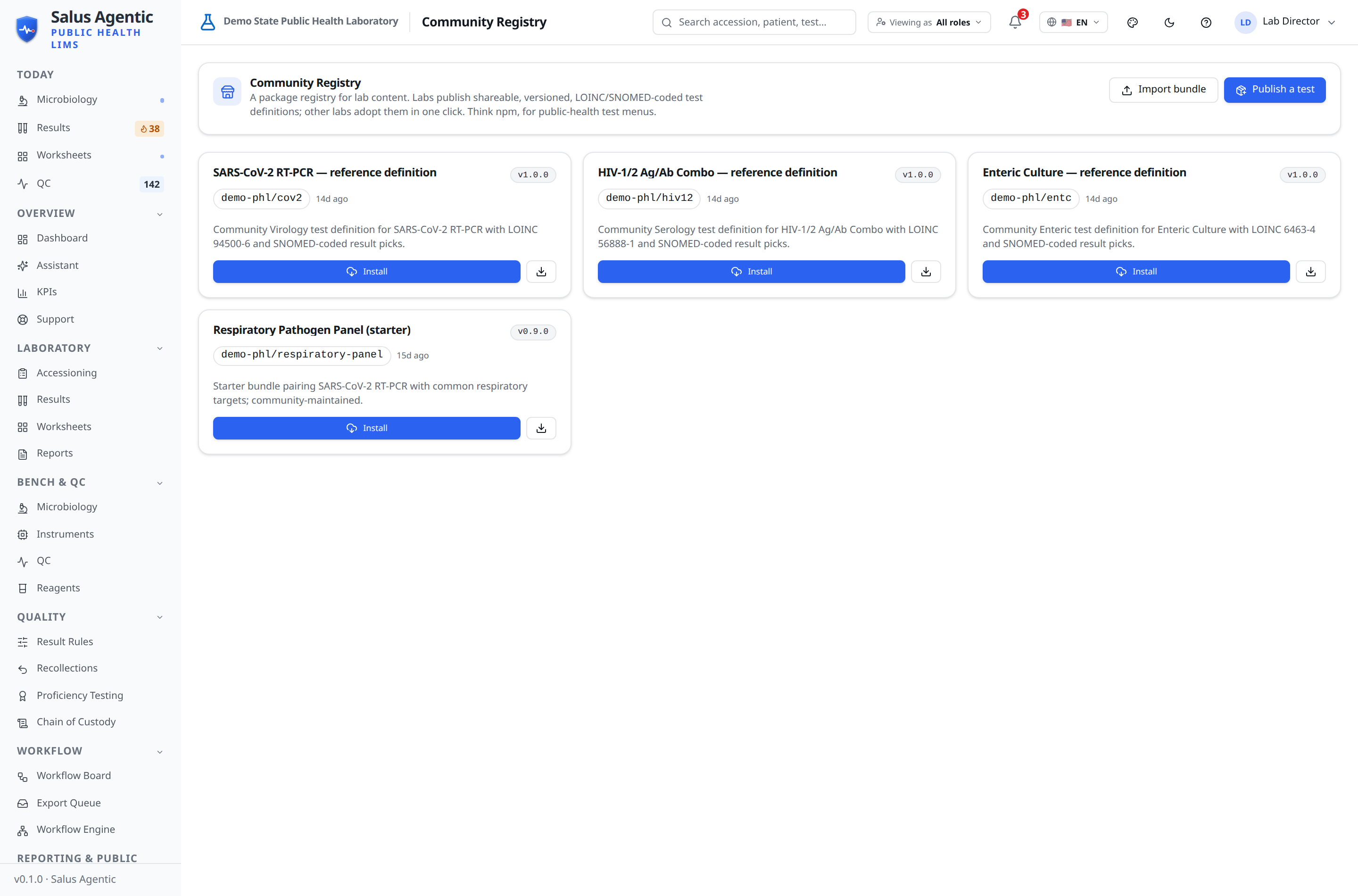
Anything that takes a lab real work to get right is worth not rebuilding. Salus makes the work portable.
A full test with its acceptable result set, reference ranges, and LOINC/SNOMED coding, ready to run.
Coded, validated result sets and interpretive rules that other labs can adopt as-is or adapt.
Intake, routing, and processing workflows proven in one lab, packaged for another.
Final, corrected, and case-report templates, so a lab does not redesign what already works.
Publish, adopt, vet, and earn. A virtuous cycle that gets stronger as more labs join.
A lab packages a test definition, workflow, or template as a versioned bundle and publishes it to the registry, with attribution.
Any lab can browse, install, and import a bundle into its own environment, then adapt it to local needs.
Because this is clinical content, an approval gate lets a lab review and sign off on a bundle before it is used in production.
When another lab incorporates a producer's content into its lab, the producer earns credits.
Good content should be rewarded. When a lab adopts a test definition, workflow, or report template you published, and puts it to use, you earn credits. The more your work is incorporated across the community, the more you earn.
Credits translate directly into things a public health lab values, so contributing to the commons lowers your own cost of running on Salus.
A shared board for local LOINC mappings, state reportable rules, validation notes, and new codes. Every starter post below is already a registry bundle with a destination lab.
SARS-CoV-2 · NAA with probe detection
LOINC 94500-6 · Detected / Not detected / Inconclusive
Open the library cardInfluenza A/B, SARS-CoV-2, RSV · Multiplex NAA + probe
LOINC 92142-9, 92141-1, 94500-6, 40988-8 · Detected / Not detected / Inconclusive
Open the library cardInfluenza A (H3, pdmH1, H5) · Target-specific NAA
LOINC 49524-2, 55465-9, 68986-9 · Detected / Not detected / Inconclusive
Open the library cardInfluenza A H5N1 · H5-specific NAA, often LDT / LRN
LOINC 68986-9 · Detected / Not detected / Inconclusive
Open the library cardDengue, Chikungunya, Zika · Trioplex-style multiplex RNA
LOINC 81154-7, 81154-7, 79190-5 · Detected / Not detected / Inconclusive
Open the library cardZika virus · NAA
LOINC 79190-5 · Detected / Not detected / Inconclusive
Open the library cardWest Nile virus · IgM EIA, often with PRNT confirmation
LOINC 31797-7 · Presumptive positive / Negative / Equivocal
Open the library cardOropouche virus · NAA, commonly LDT
LOINC 100383-8 · Detected / Not detected / Inconclusive
Open the library cardThe first labs to publish set the standard the rest of the community builds on.