
Put Extra Hands on Your Team, Not New Risks
Conrad drafts the routine work and flags what needs a human, at a defined autonomy level, and never releases a result or submits a claim on his own.
Salus is AI-native, but not AI-in-charge. The intelligence is Conrad, a single governed persona with a least-privilege permission scope, supervised by a human.
Conrad is a real worker, not a chatbot bolted on. He drafts, flags, extracts, and monitors. He never releases a result on his own. A floating assistant orb on every screen lets anyone ask him from the bench they are on.
What it does.
The full capability set, not a highlight reel.
Drafts the routine work
Accessioning from manifests, operational reports, and verifications are drafted for a person to approve in one click, never auto-committed.
Flags what needs a human
Out-of-range results, presumptive positives, QC drift, and turnaround-time risk are surfaced first, so attention goes where it matters.
Assists ELR and coding
Validates HL7 and FHIR messages and LOINC/SNOMED coding before anything reaches the state feed.
Watches for signals
Monitors test patterns for anomalies and possible outbreak signals, and drafts alerts for epidemiologist review.
The assistant orb
A floating orb on every screen is Conrad, with a proactive tip, a live operational pulse, and a one-click action.
Meet the personas.
Named workers across the lab and finance desk, each with an autonomy level, and a human in control.
Guides accessioning, results, QC, ELR, surveillance, and operations. Drafts the exhausting work. A human still signs results and transmits ELR.
The full architecture.
For your technical reviewers: the complete AI agent ecosystem, the human-in-the-loop pipeline, and the governance model behind it.
What it demonstrates
Why this reassures a cautious reviewer.
- Conrad, a governed Salus persona - he never releases results or claims alone
- A human-in-the-loop pipeline: every AI action is drafted for a person to approve
- A governance layer with bias, performance, and audit monitoring built in
- Explainability by design, so every recommendation carries its rationale
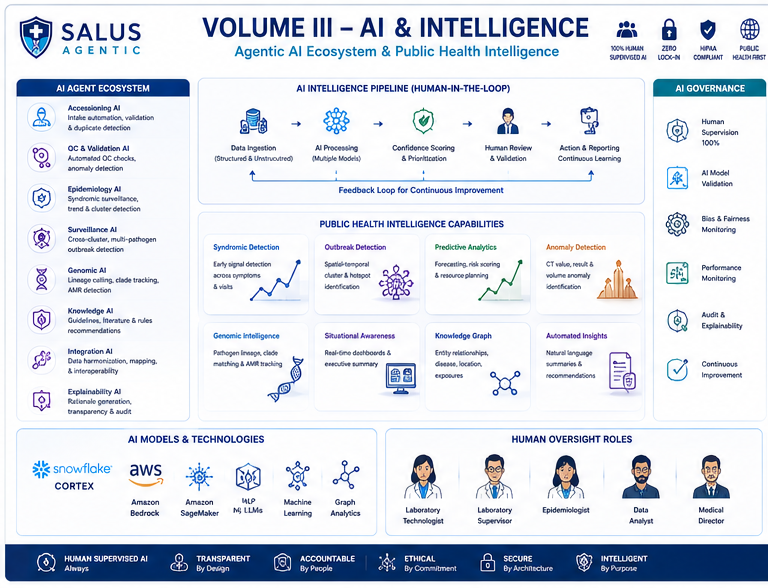
Who is in control.
- Each persona has an autonomy level: Suggest, Acts with approval, or Autonomous in scope.
- A human admin can pause or disable Conrad from the AI Personas screen.
- Disabling a persona is a human-only action. The kill switch always stays in a person's hands.
- Every status, autonomy, and scope change is written to an append-only control log: who changed what, and when.
- Personas hold scoped permissions that mirror staff roles, so a persona can never do something its human counterpart could not.
Configuration.
What your lab controls, without a vendor in the loop.
- Set each persona Active, Paused, or Disabled from the AI Personas screen
- Choose an autonomy level per persona (Suggest / Acts with approval / Autonomous in scope)
- Grant or revoke a persona's permission scope, lab by lab
- Review the full control history for any persona
See it in your laboratory's context.
Explore the live demo, no login and no request form.